01 / THE CONSTRAINT
What had to be true before changing anything.
Traditional business reporting systems (ERP, BI dashboards) provided insight into what happened, but not what is happening. Production data was delayed, siloed, or manually reported, creating gaps between shop-floor performance and business outcomes.
• Lagging production visibility (hours or days behind)
• Disconnect between operations and finance/sales
• Manual data entry or batch uploads
• Inability to react to issues in real time
This created a disconnect between operational performance and business decision-making.
02 / THE WORK
What was changed and why.
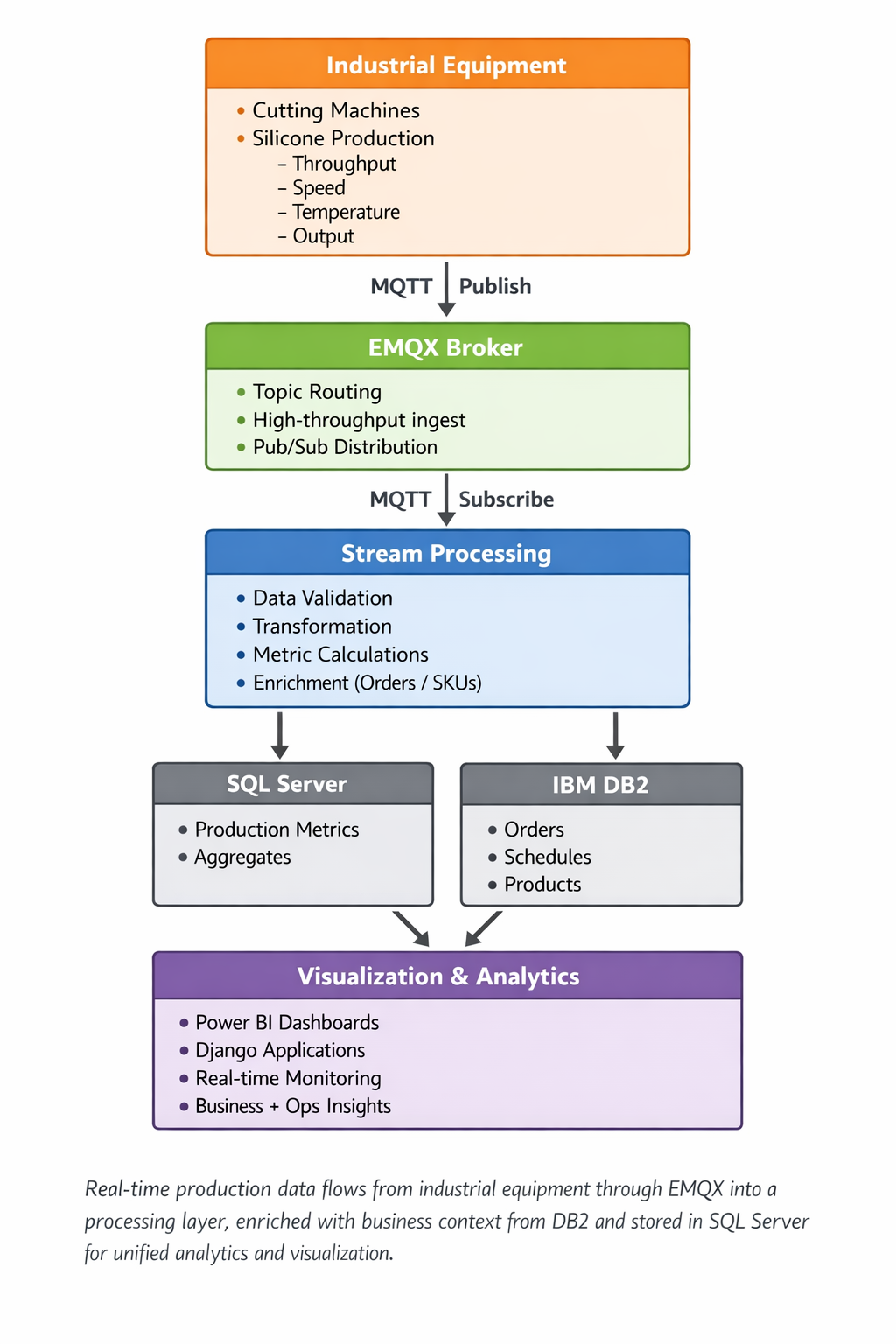
To address the lack of real-time visibility, an event-driven data pipeline was implemented using MQTT with EMQX as the central message broker.
Production equipment—including cutting systems and silicone application machines—were instrumented to publish operational data (e.g., cycle counts, throughput, temperature, and machine states) to structured MQTT topics. This enabled continuous streaming of shop-floor activity.
EMQX acted as the backbone of the architecture, efficiently ingesting and distributing high-frequency machine data to downstream consumers.
A processing layer subscribed to relevant topics and performed:
• Data validation and normalization
• Metric calculations (e.g., throughput rates, downtime duration)
• Contextual enrichment (linking production data to orders, products, and schedules)
The processed data was then integrated into both real-time dashboards and existing business intelligence systems, creating a unified view of operational and business performance.
03 / OPERATING RESULT
What became clearer, safer, or easier to run.
The implementation significantly improved visibility and responsiveness across operations and business teams.
Key outcomes included:
• Near real-time production visibility — reducing data latency from hours to seconds
• Improved operational awareness — immediate insight into machine performance and throughput
• Better alignment with business metrics — production output directly tied to sales and delivery commitments
• Faster issue detection and response — enabling proactive intervention instead of reactive analysis
• Reduced reliance on manual reporting — increasing data accuracy and consistency
Overall, the system enabled more informed decision-making by bridging the gap between live production data and traditional business reporting.
Project notes
The system was designed to capture and contextualize production data at a granular level, enabling both real-time monitoring and historical analysis.
Cutting equipment published discrete events such as cycle completions, machine states (run/idle), and downtime occurrences. In parallel, silicone production machines provided continuous telemetry, including throughput, operating speed, temperature, and output volume.
All machine data was transmitted via MQTT to EMQX using a structured topic hierarchy organized by site, production line, and machine. This ensured scalability and allowed downstream systems to subscribe selectively based on operational needs.
A processing layer consumed MQTT messages and transformed raw data into usable metrics. This included:
• Aggregating cycle data into throughput rates
• Correlating machine speed and temperature with output performance
• Tracking and classifying downtime events
Processed production data was then stored in SQL Server, where it could be queried alongside other analytical datasets.
To provide business context, production data was integrated with IBM DB2, which served as the system of record for transactional data such as:
• Sales orders
• Production schedules
• Product definitions
This integration enabled a direct relationship between machine-level activity and business outcomes. For example:
• Real-time throughput could be compared against order demand
• Production slowdowns could be evaluated against delivery commitments
• Output trends could inform purchasing and material planning decisions
By combining real-time MQTT-driven data with established enterprise systems (SQL Server and DB2), the solution created a unified analytics layer that bridged operational performance and business metrics.
Lessons learned
Implementing a real-time, MQTT-driven analytics pipeline surfaced several key insights:
• Topic design is foundational
A well-structured topic hierarchy in MQTT makes downstream processing, scalability, and debugging significantly easier. Poor topic design becomes technical debt very quickly.
• Not all data is valuable in real time
It’s tempting to stream everything, but focusing on high-impact signals (throughput, state changes, critical process variables) delivers faster value and reduces noise.
• Context transforms data into insight
Raw machine data has limited value on its own. The real impact came from enriching production data with business context from DB2—linking machine activity to orders, products, and delivery timelines.
• Data quality starts at the source
Inconsistent or noisy machine data creates compounding issues downstream. Normalization and validation at the ingestion/processing layer are essential.
• Real-time doesn’t replace traditional BI—it complements it
SQL Server and existing BI tools remained critical. The MQTT pipeline enhanced them by adding immediacy, not replacing historical analysis.
• Operational and IT alignment is critical
Success required collaboration between engineering, IT, and business teams. Bridging shop-floor systems with enterprise data is as much an organizational challenge as a technical one.
• Scalability is easy—structure is hard
EMQX handled scale without issue, but maintaining clean data models, topic standards, and processing logic required discipline as the system grew.
Ultimately, the biggest lesson was that real-time data isn’t just a technical capability—it’s a shift in how the organization observes and responds to its operations.